
Local Services Ads vs Google Ads: Which Should US Contractors Run?
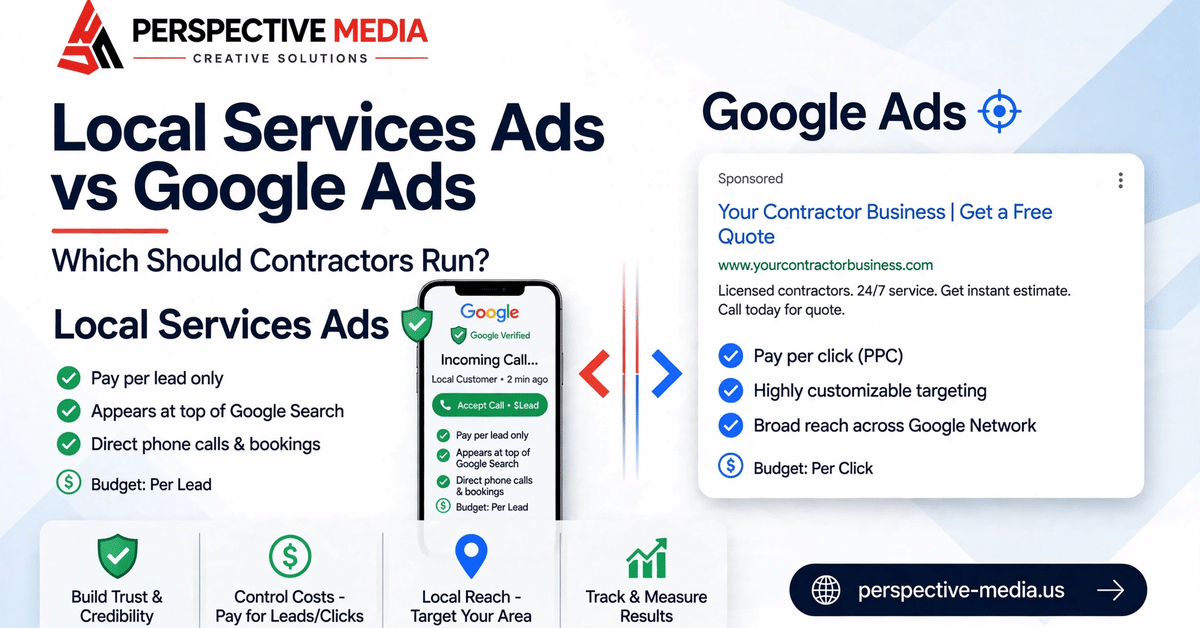
If you’re a US contractor deciding where to put your ad budget, you’ve probably stared at this exact choice: Local Services Ads vs Google Ads. Both run on Google. Both put you in front of people searching for your services. But they work on completely different economics — one charges you per lead, the other per click — and picking the wrong one first can burn months of budget.
Here’s the comparison on what matters to contractors: cost, lead quality, control, and speed — plus which channel to run first, and when running both is right.
Local Services Ads vs Google Ads: How Each One Works
These are fundamentally different products, not two flavors of the same thing.
How Local Services Ads work
Local Services Ads (LSAs) appear at the very top of Google search results — above regular Google Ads — as business profiles with photos, star ratings, review counts, and a “Google Verified” badge. Customers call or message you directly through Google. You pay per lead, not per click: a legitimate inquiry gets charged; spam or wrong numbers can be disputed through Google’s lead credit process.
Getting in requires passing Google’s screening: license verification, background checks, and insurance documentation for most trades. LSAs are only available in certain service categories and markets — check Google’s eligibility list for your trade and area. Once live, Google controls nearly everything: ad rank depends on your review count and rating, responsiveness, and proximity — not bids or ad copy, because there is no ad copy.
How Google Ads work
Google Ads (the classic pay-per-click platform) shows text, call, and image ads triggered by the keywords you choose. You control the keywords, the bids, the ad copy, the landing pages, the schedule, the geography down to a radius around a zip code, and the audience targeting. You pay every time someone clicks, whether they call you or not.
That control is powerful and dangerous. A well-built Google Ads account for a plumbing company can generate calls at a predictable cost per lead within weeks. A poorly built one burns budget on clicks from job seekers, DIY researchers, and people three states away. The difference is account structure, negative keywords, and landing pages.
Cost Compared: Pay Per Lead vs Pay Per Click
This is where most contractors start, so let’s be concrete about the mechanics — not specific prices, which vary wildly by trade and market, but how the money behaves.
With Local Services Ads, your cost is tied to outcomes. You set a weekly budget cap, and you’re charged a flat rate per lead that Google sets for your category and market. No click costs, no bidding wars, no paying for researchers. The tradeoff: you can’t bid your way to the top. If your profile has 12 reviews and the competitor has 400, they rank above you regardless of budget. And lead volume is capped by demand in your area — you can’t scale spend beyond the searches that exist.
With Google Ads, your cost is tied to auctions. Every click has a price set by competition for that keyword in that market. “Emergency plumber Dallas” costs far more per click than “drain cleaning tips.” Your cost per lead depends on click-through rate, landing page conversion rate, and how well you filter junk with negative keywords. The upside: there’s no ceiling. If the math works, you can scale as far as your operations can handle the calls.
The honest summary: LSAs give you cost certainty per lead with limited scale and control. Google Ads gives you unlimited scale and full control with cost uncertainty until the account is tuned.
Lead Quality: Which Channel Sends Better Jobs?
For contractors, ten cheap leads that don’t book are worth less than three expensive ones that do. Here’s how the channels differ on quality.
Local Services Ads leads tend to convert well for one structural reason: the customer chose your profile — your face, your reviews, your badge — before calling. They’ve pre-qualified you. LSA callers are often further along in the decision; they picked you out of three visible options rather than clicking the first ad they saw. The Google Verified badge also borrows Google’s trust, which matters enormously for trades where letting a stranger into your home is the transaction.
Google Ads lead quality is entirely what you make it. Broad keywords (“plumber”) attract researchers and price shoppers; specific, intent-rich keywords (“water heater replacement cost Austin”) attract buyers. Call-only campaigns, tight geo-targeting, ad scheduling around your availability, and landing pages that match the ad’s promise all push quality up.
One more quality factor: reviews feed both channels. LSA ranking directly rewards review count and rating, and Google Ads click-through rates climb with strong star ratings. If your review base is thin, fix that before spending heavily on either — our guide to getting more Google reviews covers a system that works within Google’s rules.
Control and Targeting: Where Google Ads Wins
If control matters to you, this section is short: Google Ads wins, and it’s not close.
With Google Ads you choose exactly which searches trigger your ads, write the message the customer sees, decide where they land, set the hours your ads run, and pause the moment you’re booked solid. Launching a new service line? Build a campaign for it this afternoon. Slow season? Shift budget to the service that still has demand. Want to target homeowners in specific zip codes and exclude renters? Done.
With Local Services Ads you get a profile, a service list, and a budget cap. Google decides when your ad shows, where it ranks, and what the customer sees. You can’t write ad copy, choose landing pages, or target by keyword. For many contractors this simplicity is a feature — there’s nothing to mismanage — but if you like pulling levers, LSAs will feel restrictive.
The Local Services Ads vs Google Ads Decision Framework
Here’s how to decide, based on where your business stands today.
Run Local Services Ads first if:
- You’re in an eligible trade and market, and you can pass screening quickly.
- You have (or can quickly build) 20+ Google reviews — LSA ranking is review-driven.
- You want leads with minimal management overhead and predictable per-lead costs.
- Your Google Ads account would be starting from zero with no one experienced to manage it.
Run Google Ads first if:
- LSAs aren’t available for your trade or market.
- You need volume beyond what local LSA demand can supply.
- You want to target specific services, offers, or customer segments LSAs can’t isolate.
- You have (or are hiring) competent management — the control is only valuable if someone uses it well.
Run both when:
- LSAs are profitable but capped — Google Ads captures the demand LSAs can’t reach.
- You want defense and offense: LSAs for efficient baseline leads, Google Ads for growth, new services, and competitive conquesting.
- Your operations can handle the combined call volume without response times slipping. Speed-to-lead matters on both channels.
One thing to avoid: splitting a small budget across both channels so thinly that neither gets enough data. If your total budget is modest, pick one, make it work, then expand.
How to Get Started on the Right Channel
Whichever you choose, the setup sequence matters.
For Local Services Ads: verify eligibility, gather your license and insurance documents, start the background check process early (it’s the slowest step), and build your review base in parallel — every week of waiting is a week you could be collecting reviews. Set your service types and service areas carefully; narrower, accurate targeting beats broad every time.
For Google Ads: start tight — one campaign per core service, exact and phrase match keywords, a strong negative keyword list from day one, call tracking on every lead, and landing pages that match each ad’s promise. Set a test budget you can sustain for 60–90 days; judging an account on two weeks of data is how good accounts get killed early.
Either way, measure cost per booked job, not cost per click or even cost per lead.
The Bottom Line
Local Services Ads vs Google Ads isn’t a rivalry — it’s a sequencing question. LSAs offer pay-per-lead simplicity with the Google Verified badge and strong intent, but limited control and scale. Google Ads offers total control and unlimited scale, but demands real management to avoid waste. Most US contractors who advertise seriously end up running both, in that order.
If you want help making that call for your specific market — or managing either channel so the math works — take a look at our services and reach out to Perspective Media. We run both channels for US contractors every day, and we’ll tell you straight which one deserves your budget first.
2 responses