
Meta Commercial Terms and AI Features: What US Advertisers Must Audit Before November 20
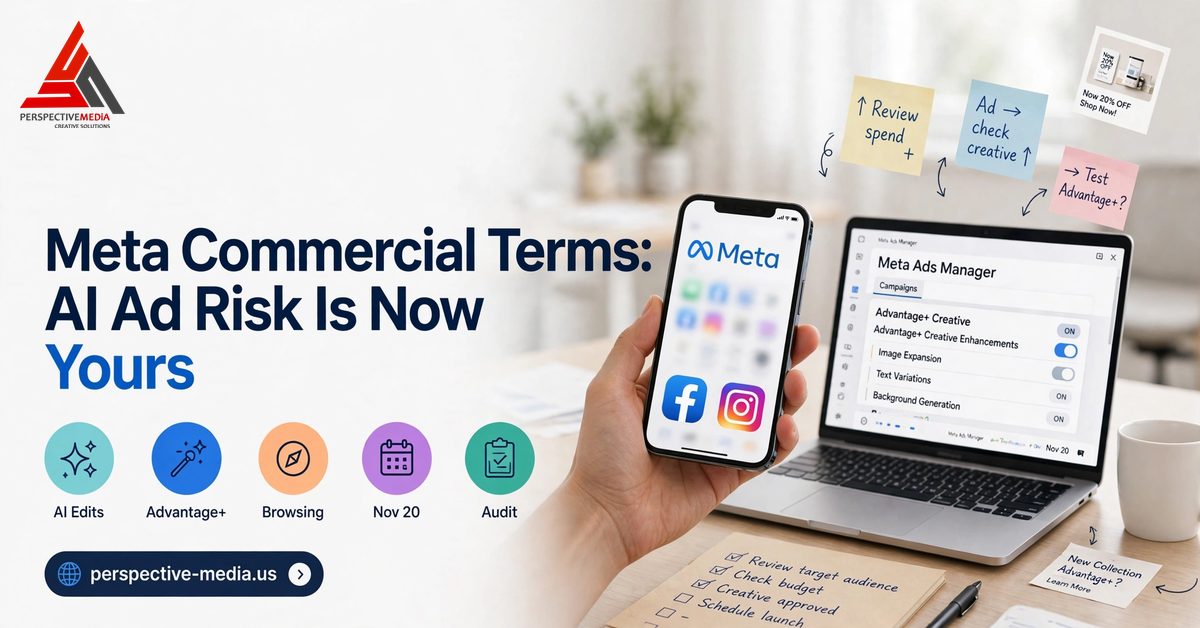
Meta commercial terms AI features are about to change who carries the risk when AI touches your ads. Under Meta’s updated Commercial Terms and Self-Serve Ad Terms, which take effect on November 20, 2026, advertisers are solely responsible for the risks of AI-created or AI-changed ad content — including content Meta’s own tools generate or alter, and including features Meta switches on itself. That allocation of responsibility is the update’s most important sentence for US advertisers.
The date matters because it moved. Meta told Reuters it pushed the effective date back by three weeks to give itself time to explain what is changing and what is not, after publishers and advertisers complained to competition authorities in the EU and the UK. The delay is breathing room, not a reprieve: the practical work should happen now, not in the week the terms take effect. This is a practical summary, not legal advice.
Meta Commercial Terms and AI Features: What Actually Changed
Two documents move together on November 20: the Commercial Terms, the master contract for business use of Meta’s products, and the Self-Serve Ad Terms, which apply whenever an advertiser uses Ads Manager or another self-serve interface. Acceptance needs no signature: continuing business use after the effective date counts as acceptance — which is why the date deserves attention.
The clause US advertisers should read first is the AI Features section. In plain terms, it says Meta may provide AI features that create, optimise or enhance content, and that the advertiser acknowledges those features may make mistakes and may not always be accurate, complete or suitable. The advertiser is solely responsible for, and assumes all risks of, the AI features and the content they produce — including judging whether that content is suitable for its business purposes. The clause also says users must not alter or remove AI-generated watermarks or content-authenticating metadata.
A second, separate clause drew the publisher complaints: the website-crawling permission. It authorises Meta, or entities acting for it, to use automated software — scrapers, bots, crawlers and similar tools — to access, index, cache, analyse, collect and retrieve pages associated with a business’s products or services, and to pull updates from them periodically. The stated purposes are providing, developing, improving, researching and maintaining advertising and business products, helping create and deliver ads, and keeping Meta’s products secure. Reports indicate Meta removed one word — “train” — from this clause during October, but publisher groups argue the practical scope did not narrow, because Meta’s advertising and business products now include its AI tools. The controversy is mainly a publisher story; the liability clause is the advertiser story.
Why Meta Commercial Terms AI Features Matter for US Advertisers
The liability clause matters because of how Meta’s ad tools actually work today. Advantage+ creative enhancements can already alter your ads without you touching them: removing or replacing backgrounds, adjusting image ratios, generating text variations, adding music, or reshaping a static image into a video-style format. Some enhancements are on by default, and each one is a separate setting. Before November 20, a bad AI edit was Meta’s feature misbehaving. After November 20, under the new terms, it is your content, with your responsibility attached — including the risk that an AI-generated claim about your product is inaccurate, or that an AI-altered image misrepresents what you sell.
That risk is not theoretical for service businesses. An AI text variation that invents a guarantee you do not offer, a background swap that puts your product in a setting you would never claim, or a cropped image that cuts out a required disclaimer can all run inside a live campaign before anyone notices. The terms do not require Meta to show you every change before it serves. They require you to own the result.
The Other Switch Flipping Today: Product Browsing On by Default
Separate from the November 20 terms, a second Meta change lands today, October 28, and it needs a decision before you finish reading this post. Meta is switching product browsing on by default for ads that are already running, unless the advertiser opts out. Product browsing is an Advantage+ creative option: when it is on, a person who taps your ad may see a page inside Facebook or Instagram showing product information and suggestions, instead of going straight to your website.
Meta’s justification, reported from its advertiser notice, is an average conversion improvement of around 3 percent from an August experiment across roughly 117,700 advertisers. Meta has not publicly defined which metric that figure counts, and an average across every kind of advertiser says nothing about your account. For e-commerce advertisers with a catalogue, an in-app product view may genuinely help. For lead-generation advertisers — contractors, clinics, local services — an extra step between the ad tap and the landing page can cost you the call, the form fill or the booking that the ad was bought to produce, and your pixel only sees what happens on your own site.
You can opt out from the notice in Ads Manager, or turn it off ad by ad in the Advantage+ Creative and Destination settings, at any time. The point: doing nothing is now a choice in favour of product browsing.
What to Do Now: The Pre-November 20 Audit
1. Audit every Advantage+ enhancement, ad by ad
Open Ads Manager and check every enhancement on each live ad: text variations, image enhancements, background changes, format changes, music, and product browsing. Decide each one on its merits for that specific ad. An enhancement that is harmless on a catalogue ad can be dangerous on a lead ad carrying a regulated claim. Turn off anything you would not approve if a junior employee proposed it, because under the new terms, you are approving it.
2. Decide product browsing today, per campaign objective
For Sales campaigns with a catalogue, test it on a small budget and compare conversion quality, not just volume. For lead, booking or call campaigns, the safer default is off until you have evidence it does not hurt your cost per lead. Our guide to Snapchat ads for small business covers a similar discipline: every platform default deserves a deliberate answer, not an inherited one.
3. Review what Meta’s tools can reach on your website
Because the crawling clause covers pages associated with your products or services, take stock of your public website: pricing pages, service descriptions, testimonials, anything you would not want summarised or repurposed inside an AI product. Meta has said website owners can still use robots.txt to signal crawler preferences, and describes honouring those preferences as practice — but the contract text itself does not promise it. Treat robots.txt as a signal, not a shield, and keep genuinely sensitive material off public pages entirely.
4. Put a human approval step on AI-touched creative
From now on, treat any ad Meta’s AI has enhanced as a draft until a human has reviewed it. Build a simple weekly check: open your top-spending ads, view the live creative as a user would see it, and confirm the claims, images and disclaimers are all ones you stand behind. The same discipline applies to automation elsewhere in a service business — as we covered in our post on missed-call text-back automation, the tool does the volume work, but a human owns the outcome.
5. Watch reporting for the next two changes, not just this one
October 28 and November 20 are two items in a crowded month of Meta defaults. Keep an eye on cost per lead, landing-page view rate and conversion rate by campaign for the next four weeks, and compare against your pre-October baseline. If landing-page views fall while clicks hold steady, product browsing may be intercepting traffic.
6. Calendar the date and brief your team
Put November 20 on the calendar, brief anyone who touches your ad accounts, and complete the enhancement audit before it arrives. If you work with an agency, ask them in writing which enhancements are on across your accounts. The terms make the advertiser responsible; outsourcing the work does not outsource the responsibility.
Meta Commercial Terms and AI Features: The Bottom Line
Meta commercial terms AI features boil down to a simple trade: Meta’s AI will keep editing, enhancing and optimising your ads, and from November 20 the risk of whatever it produces sits with you. Use the three-week window. Audit every Advantage+ enhancement ad by ad, decide product browsing per campaign objective today, review what your public website exposes, and put a human approval step between AI output and live spend. Do that work now, and you enter peak season with AI working for you under terms you actually understand.
If you want a second pair of eyes on your ad accounts before November 20, our paid advertising planning guides follow exactly this discipline — platform defaults checked deliberately, creative reviewed by humans, and performance judged on the leads and sales that actually arrive.