
Pinterest Ads for Business: A Guide for Home, Decor & Lifestyle Brands
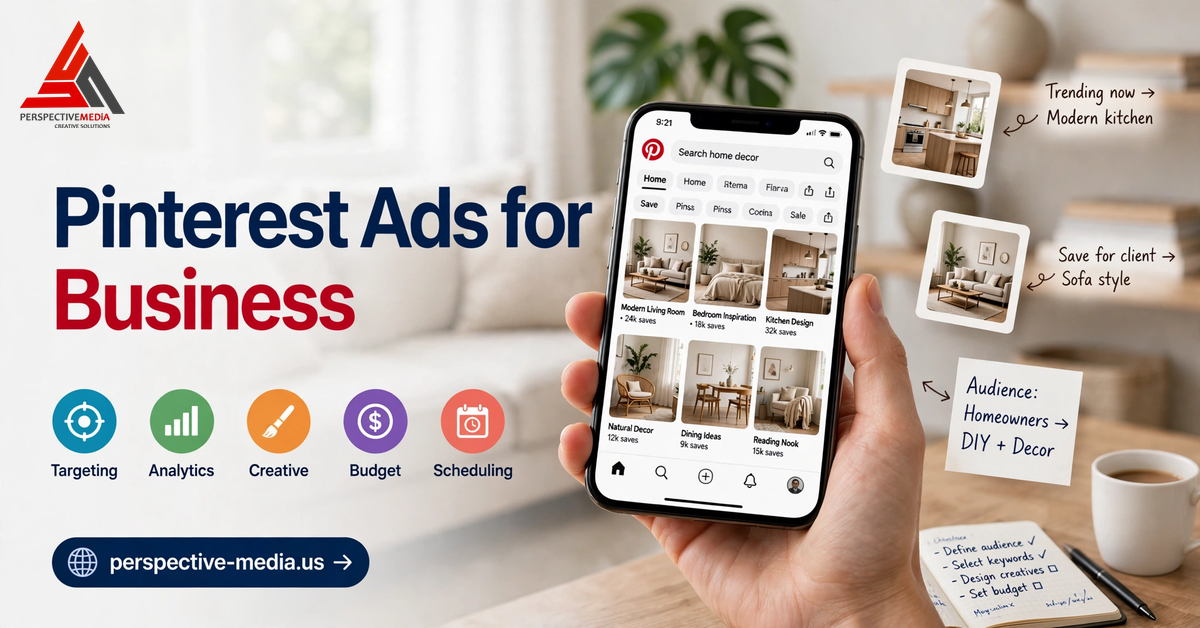
Pinterest ads for business work on a different moment from every other social ad you run. On Instagram or TikTok, you interrupt someone who is scrolling for entertainment. On Pinterest, you meet someone who is already planning — a kitchen remodel, a nursery, a holiday table, a new sofa. That planner is further along than a scroller, and for home, decor, and lifestyle businesses, that difference is the whole opportunity.
Pinterest is a visual search engine as much as a social network. People save Pins to boards for months before they buy, and they search with the intent of a shopper, not a browser. A home goods brand that treats Pinterest like another feed to post into will waste money. A brand that treats it like a planning tool — searchable, saveable, shoppable — can turn one good Pin into sales for years, because Pins keep circulating long after a Story or Reel has vanished.
This guide covers how Pinterest ads actually work for home, decor, and lifestyle businesses: which objectives and formats fit, how targeting differs, what creative wins, what to budget, and the measurement setup that stops you from flying blind.
Pinterest Ads for Business: Why Home and Decor Brands Fit
Pinterest’s audience is planning purchases in exactly the categories home and lifestyle brands sell. Furniture, lighting, bedding, kitchenware, paint colours, garden design, wedding styling, holiday decor — these are the boards people build. A user planning a living room refresh will save twenty Pins before buying one sofa, and every save is a signal of intent that no other platform captures as cleanly.
Three properties make the fit especially strong. First, the planning window is long. A Pin saved in October can drive a purchase in January, which means your ads compound rather than expire. Second, the search behaviour is commercial: Pinterest itself reports that more than half of its tens of billions of monthly searches are commercial in nature. Third, the audience skews toward the household decision-maker — the person choosing the paint, the bedding, the tableware — rather than the casual browser.
That does not mean Pinterest replaces Meta or Google. It means it earns a specific job in your media mix: capturing high-intent planners early, while they are still building the shortlist your competitors will fight over later. Our guide to Snapchat ads for small business covers the opposite end of the funnel — fast, young, impulse-driven attention — and the contrast is instructive. Pinterest is slow intent; Snapchat is fast attention. Budget them differently.
Pinterest Ads for Business: Objectives That Match Your Goal
Pinterest Ads Manager organises campaigns around objectives, and choosing the wrong one is the most common beginner mistake. Pinterest’s own campaign objective guide lays out the current set: brand awareness, video completion, consideration, leads, and sales. Each objective changes how you bid and which formats are available, so the choice is not cosmetic.
For home, decor, and lifestyle businesses, the practical mapping looks like this:
- Consideration is the starting point for most brands. It optimises for Pin clicks or outbound clicks, which is what you want when you are driving planners to product pages, lookbooks, or room guides. Use it to test creative and audiences before committing to conversion optimisation.
- Sales is the objective once you have conversion tracking working and enough purchase volume for the system to learn from. It optimises for checkouts and add-to-baskets, and it pairs with a product catalogue for shopping ads.
- Leads fits businesses that sell by consultation — interior designers, custom furniture makers, remodelers — where the conversion is a form fill, a booked call, or a showroom visit rather than a checkout.
- Brand awareness and video completion are upper-funnel tools. Use them for a seasonal launch or a new collection, not as your always-on engine, because they optimise for reach and views rather than actions.
Pinterest has also simplified its objectives over the past year, replacing the older conversions and catalogue sales objectives with leads and sales. If you are following an old tutorial that references the legacy names, translate before you build — the bidding and optimisation logic has moved with the new names.
Pinterest Ads for Business: Formats Worth Your Budget
Formats on Pinterest are not interchangeable, and home and lifestyle brands have a natural advantage: your products are visual, and Pinterest rewards visual products.
Standard image Pins are the workhorse. A single beautiful, vertical image (2:3 ratio, at least 1000 x 1500 pixels) with a clear product, a readable headline, and a destination that matches the image. For furniture and decor, lifestyle photography beats product-on-white: a sofa in a real room outsells a sofa on a grey background, because the planner is imagining it in their room.
Video Pins earn their place when the product needs context — how a lamp looks when switched on, how a fabric moves, a room transformation in fifteen seconds. Keep them short, front-load the product, and design for sound-off viewing with text overlays, since many users browse silently.
Carousel Pins let a planner swipe through a collection: one room, five angles, or five products that belong together. They work well for bedding sets, table settings, and curated collections where the sale is the set, not the single item.
Collection and shopping ads are the product-led formats. A hero image with tappable product tiles underneath turns a Pin into a mini storefront. If you sell through a catalogue, these are your highest-intent format, because the click lands on a product page with a price, not a blog post. Pinterest’s own guidance notes that shopping ads show a price tag icon beside the Pin title, which pre-qualifies the click — the planner already knows the price before they tap.
Skip quiz ads and showcase formats until your core formats are proven. Novelty formats are tempting, but a home brand with three winning standard Pins will outperform a brand with one of everything and no clear winner.
Pinterest Ads for Business: Targeting Planners, Not Audiences
Pinterest targeting rewards a different instinct from Meta. On Meta, you layer interests and behaviours until the audience feels precise. On Pinterest, the strongest signals are keywords and intent — what people search for and save — and over-layering is the fastest way to starve a campaign.
Start with keyword targeting built from real planner language: “modern farmhouse living room,” “small bedroom storage ideas,” “terracotta kitchen tiles,” “holiday table setting.” Use Pinterest Trends and your own search data to find the phrases planners actually type, not the phrases your industry uses internally. Then add one interest layer at a time — home decor, DIY, gardening — and read the result before adding another.
Actalike audiences, built from your site visitors or customer lists, are the second layer worth testing once you have traffic. They find planners who behave like your buyers, which is valuable for prospecting beyond keyword searches. Retargeting is the third layer and usually the highest-returning: site visitors, Pin engagers, and past purchasers, shown the product they viewed or its natural companion piece.
Geography matters more than most brands expect. A furniture brand shipping only within the US should not pay for planners in markets it cannot serve, and a local showroom or interior designer should radius-target around its service area. Pinterest lets you target by location; use it before you spend a dollar on broad prospecting.
Pinterest Ads for Business: Creative That Gets Saved
A Pinterest ad succeeds twice: first when it earns the click, and again when it earns the save, because a save puts your Pin on someone else’s board, in front of their followers, for months. Creative that gets saved looks different from creative that gets clicked on other platforms.
Five rules hold for home, decor, and lifestyle creative:
- Show the product in context. A styled room, a set table, a made bed. Planners save rooms, not products. The product should be identifiable, but the scene is what earns the save.
- Keep text overlay light and legible. One short headline, large type, high contrast. Pinterest’s own editorial standards reject ads with tiny, blurry, or excessive text overlay, and planners skip Pins they cannot read at a glance.
- Design vertical, always. The 2:3 ratio dominates the feed. A square or landscape image wastes screen space and loses the save to a taller competitor.
- Match the destination. If the Pin shows a sage green sofa, the landing page must show that sofa, not your homepage. Pinterest’s advertising guidelines are explicit: ads cannot imply a product is available on the landing page if it is not, and landing pages that force an unrelated journey get rejected. Pinterest’s advertising guidelines are worth reading before your first campaign, not after your first rejection.
- Test variations, not redesigns. Change one element at a time — the headline, the room styling, the price display — so you learn what moved the result. Four to six variants per product, run for two to three weeks, beats one “perfect” Pin that nobody tested.
Seasonality is your creative calendar. Planners start holiday decor searches months early, spring refreshes in late winter, and outdoor living as soon as the weather turns. Build creative a season ahead, not the week it starts, because Pins need time to gain saves before the buying window peaks.
Pinterest Ads for Business: Budgets and Measurement That Work
Pinterest rewards patience, which makes budgeting discipline especially important. A realistic test for a home or lifestyle brand is $20 to $50 per day per campaign for three to four weeks — enough to buy a few thousand impressions, test creative variants, and learn whether cost per click and cost per action are in a viable range. Below that, the system cannot learn, and you will judge a channel on noise.
Measure with the Pinterest tag plus the API for Conversions, with deduplication between the two, and UTM parameters on every ad. Without that setup, you cannot tell whether a sale came from Pinterest, from a later Google search by the same planner, or from an email they opened after saving your Pin. Pinterest’s measurement is genuinely harder than Meta’s, because the journey is longer — save today, buy in six weeks — so judge campaigns on a longer window than you would a Meta campaign, and track saves and outbound clicks alongside purchases.
Three numbers decide whether Pinterest earns a permanent budget line: cost per outbound click against your other prospecting channels, save rate as a leading indicator of creative quality, and cost per acquisition measured over a 30 to 60 day window, not seven days. If outbound clicks are competitive and saves are strong but purchases lag, the problem is usually the landing page or the follow-up, not the Pin — the planner arrived interested and left unconvinced.
Pinterest Ads for Business: Mistakes That Waste the Test
Most failed Pinterest tests fail for the same handful of reasons. Sending Pin traffic to a homepage instead of the product or room shown in the Pin is the most expensive one — the planner’s intent dies on a generic page. Running one creative and calling the channel a failure is the second; Pinterest is a creative-testing channel, and one Pin proves nothing. Targeting too narrowly, with five layers stacked on a small budget, is the third — the campaign never delivers enough to learn from.
A subtler mistake is judging Pinterest on Meta’s timeline. A campaign that looks weak after seven days may be building saves that convert in week six. Kill losers on click and save data after three weeks, but do not kill the channel on seven-day purchase data. And do not ignore the organic side: a business account with well-organised boards, keyword-rich Pin titles, and consistent posting gives paid Pins a stronger profile to land on, and organic Pins that gain traction are your best candidates to promote.
The Bottom Line
Pinterest ads for business suit home, decor, and lifestyle brands because the platform’s core behaviour — planning, saving, searching with intent — matches how people actually buy for their homes. Choose the objective that fits the outcome you want, lead with standard and shopping formats, target by planner keywords before layering audiences, create vertical Pins that show products in real rooms, and measure over a window long enough for planners to become buyers.
Start with one product line, three to five creative variants, and a four-week test at a budget the system can learn from. If outbound clicks are competitive and saves are strong, scale the winners and expand to the next collection. If they are not, fix the destination page and the creative before blaming the channel — the planners are there, and they are already building boards your products belong on.
Our guide to answer engine optimization covers the other side of being found when buyers ask questions, and our internal linking strategy shows how to route the traffic those channels send toward the pages that convert. If you would like a read on whether Pinterest — or another channel — deserves your next ad dollars, get in touch and we will map your audience, your competitors’ presence, and the channels most likely to produce customers for your business.