Facebook Retargeting for Local Business: How US Local Businesses Win Back Lost Leads
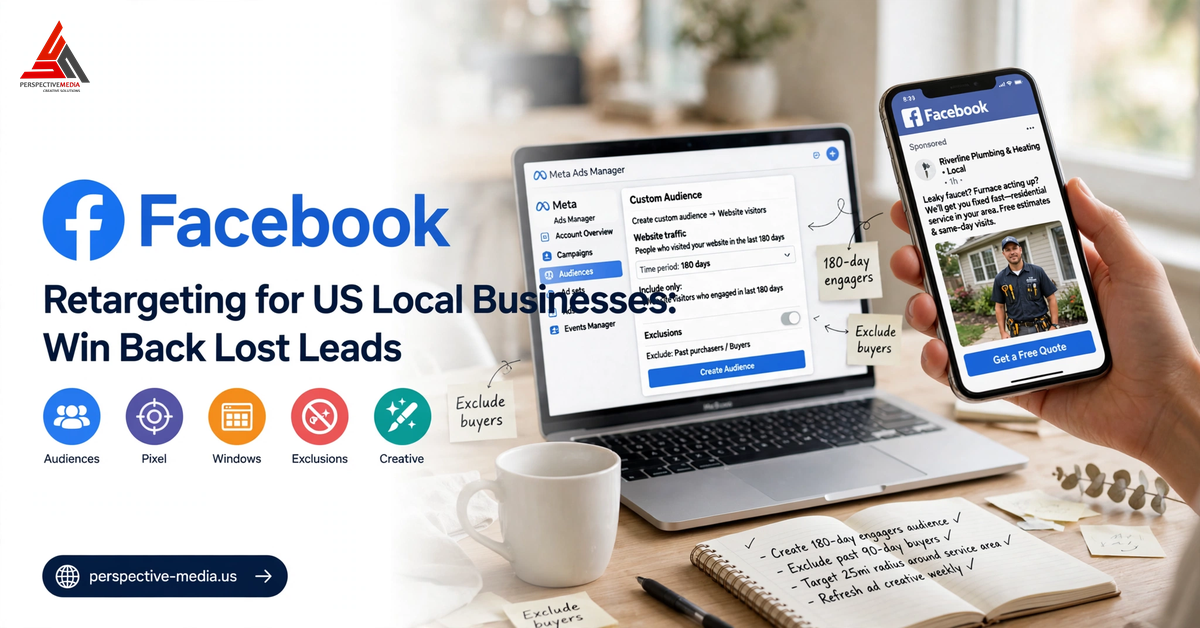
A homeowner visits your quote page at 11 p.m., gets distracted, and never submits the form. Facebook retargeting for local business puts your offer back in front of that exact person the next morning. Here’s how to recover lost quote requests instead of just buying impressions.
Why Facebook Retargeting for Local Business Outperforms Cold Ads
Cold advertising introduces you to strangers. Retargeting re-closes people who already raised their hand. A visitor who read your pricing page or started a quote form is worth multiples of a cold click — they know the business, considered the service, and simply didn’t finish.
The cost math helps too. In LocaliQ’s 2026 Facebook Ads benchmarks, average CPC for traffic campaigns was just $0.60, with Meta’s average CPC running less than half of Google’s. Benchmark data has long noted that remarketing on Facebook can be particularly powerful for improving conversion rates — every dollar reaches demonstrated intent rather than predicted interest.
You don’t need massive traffic. A roofing company with 800 monthly quote-page visitors has a perfectly viable audience — the goal is recovery, not reach.
How Retargeting Works Inside Meta Ads Manager
Everything runs through Meta Ads Manager — the ad interface for Facebook, Instagram, Messenger, and the Audience Network. Retargeting starts with Custom Audiences built from your own data:
- The Meta Pixel — code on your site that fires when visitors view pages, start forms, or reach thank-you pages. Builds your website Custom Audience automatically.
- Engagement audiences — people who watched your videos, opened your lead forms, engaged with your page, or messaged you. No website code needed.
- Customer lists — emails or phone numbers from your CRM, matched to user accounts.
Connect Meta’s Conversions API (CAPI) alongside the Pixel. CAPI sends events from your server, recovering conversion data lost to ad blockers and iOS privacy prompts. For local advertisers living on quote-form submissions and calls, it’s the difference between Meta optimizing on guesses and on real conversions.
One caution: Advantage+ audience lets Meta expand delivery beyond your Custom Audience. That defeats a strict win-back campaign — keep retargeting audiences tight.
Build Your Four Core Retargeting Audiences
These are free to build and accumulate visitors even while ads are paused.
Website Visitors via the Meta Pixel
Build a website Custom Audience of site visitors from the last 60 days, plus a tighter one: people who hit your quote, booking, or pricing pages but never reached the thank-you page. That second group is your money audience — the literal definition of a lost quote request. Exclude converted leads from both.
Video Viewers and Social Engagers
A 30-second video on “how we price a roof replacement” is cheap to promote and builds a durable pool. Add audiences of 50%+ video viewers and profile engagers.
Lead Form Starters Who Never Submitted
Facebook Lead Ads use native in-app forms that pre-fill contact details, with average CTR on leads-objective campaigns at 2.70%. Many users open the form and bail — retarget openers who never submitted with a reminder ad.
Customer Lists and Exclusion Audiences
Upload existing customers and closed jobs as a Customer List, and exclude it from every retargeting campaign. Nothing burns goodwill like “get a free quote” ads served to someone whose roof you installed last month. Missing exclusions is where most local advertisers leak money.
The 4 Retargeting Campaigns That Win Back Lost Quote Requests
Run one campaign per audience, each with one job:
- Quote-page abandoners (30 days). Viewed quote or pricing pages, never submitted. Creative: a direct reminder plus a sweetener — free inspection, priority scheduling, a seasonal discount. Highest-ROAS campaign; give it the biggest budget share.
- Service-page browsers (60 days). Read service pages but never reached the quote step. Creative: educational and trust-building — before/after carousels, a 60-second explainer, review screenshots.
- Lead-form abandoners (14 days). Short window, urgent creative: “You were one tap away — pick up where you left off.” And follow up fast everywhere: our speed-to-lead data shows how response speed separates won jobs from lost ones.
- Past visitors and engagers (180-day nurture). A low-budget brand reminder with seasonal offers and social proof. When their need arrives months later, your name is the familiar one.
Pair the ads with a missed-call text-back system — many “lost” quote requests are just missed calls nobody followed up, recoverable with zero ad spend.
Facebook Retargeting for Local Business: Budget, Windows, and Frequency
Budget sizing for small advertisers
Size the budget to the audience, not your ambition. A $15/day budget against a 2,000-person audience hammers frequency fast. Start at $10–$25 per day total across retargeting — roughly 10–20% of total Meta spend. Tiny audiences (under 1,000 people) need $5–$10/day or a wider window. Set frequency caps at the ad-set level, and rotate 2–3 creative variants monthly.
Choosing your retargeting windows
Match the window to the buying cycle: emergency services decide in hours — 14 days is plenty. High-ticket purchases (roofing, remodeling, solar, legal) deserve 60–90 days, with a 180-day nurture campaign catching stragglers. When unsure, start at 30 days and extend once reports show where conversions cluster.
The settings that protect your budget
Exclude converters, exclude customers, and cap frequency. For broader context on how Meta’s ad platform is evolving around AI-driven creative and placement features, see our writeup on Meta’s commercial terms and AI features.
Offers and Creative That Convert Warm Traffic
Warm traffic converts on reassurance, not discovery. Remove the last objection:
- Social proof first. Review counts, star ratings, one-line customer quotes in the image or first two lines of copy.
- Guarantees and risk reversal. “Free estimates,” “no-obligation inspection,” “licensed and insured.” Say it plainly.
- Urgency with a reason. “Storm season is booking out” beats “limited time offer” because it’s true.
- Dynamic ads for retailers. If you sell products, Meta’s dynamic ads show each visitor the items they viewed. Service businesses should stick with custom creative.
Put the offer in the first line of copy, and always include a click-to-call or click-to-text option — most local retargeting traffic arrives on phones. When cheaper reach makes more sense than intent-based recovery, see our breakdown of TikTok Ads for small businesses.
Measuring Retargeting in the iOS/ATT Era
Apple’s App Tracking Transparency (ATT) shrank the iOS conversions Meta can observe. Three responses:
- Send events server-side with CAPI. The single biggest measurement upgrade available to a local advertiser.
- Track with UTMs, not just Meta’s dashboard. Tag every ad so your CRM shows which campaign produced the lead, independent of Meta’s attribution. When the numbers disagree, trust the CRM.
- Judge on business metrics. Benchmark data puts Home & Home Improvement lead campaigns at 2.14% CTR, with typical home-improvement Facebook CPA near $45 — but your yardstick is cost per booked job. A $40-CPL retargeting campaign that closes 30% of quotes beats a $12-CPL cold campaign that closes 3%.
Frequently Asked Questions
How much should a local business spend on Facebook retargeting?
Start with $10–$25 per day across your retargeting campaigns — 10–20% of your total Meta ad budget. Scale only when frequency stays controlled and cost per booked job stays profitable.
How long should my retargeting window be?
Match the window to how customers buy: 14–30 days for emergency services, 30–60 for most home services, 60–90 for high-ticket jobs, plus a 180-day nurture campaign. Start at 30 days and extend once reports show where conversions cluster.
Does Facebook retargeting still work after iOS 14 and ATT?
Yes, with server-side measurement. Connect Meta’s Conversions API so events reach Meta even when browsers block the Pixel, and track results with UTMs in your own CRM.
Should I use Advantage+ audience or manual targeting?
Keep strict win-back campaigns manual: a defined Custom Audience with exclusions for customers and converters. Advantage+ lets Meta expand beyond your list, diluting the focus that makes retargeting profitable. Use Advantage+ for prospecting instead.
How do I stop showing retargeting ads to people who already converted?
Build exclusions three ways: a website Custom Audience of thank-you-page visitors, a Customer List upload of closed jobs, and a list of submitted leads. Apply all three on every retargeting ad set, and cap frequency so nobody sees the same ad more than a few times per week.
Get Your Lost Leads Back
Facebook retargeting for local business works because it spends your budget on the warmest traffic you own — people who already found you and almost converted. Build the Pixel and CAPI foundation, define your four core audiences, exclude your customers, and let tight windows and fresh creative do the recovery work.
Perspective Media runs paid social for US local businesses every day — from Pixel and Conversions API setup through audience strategy, creative, and lead tracking tied to booked jobs. It pairs well with our Google Ads management: search captures the demand, retargeting recovers what slips through. If your quote requests are slipping through the cracks, let’s talk about a setup built around your buying cycle.